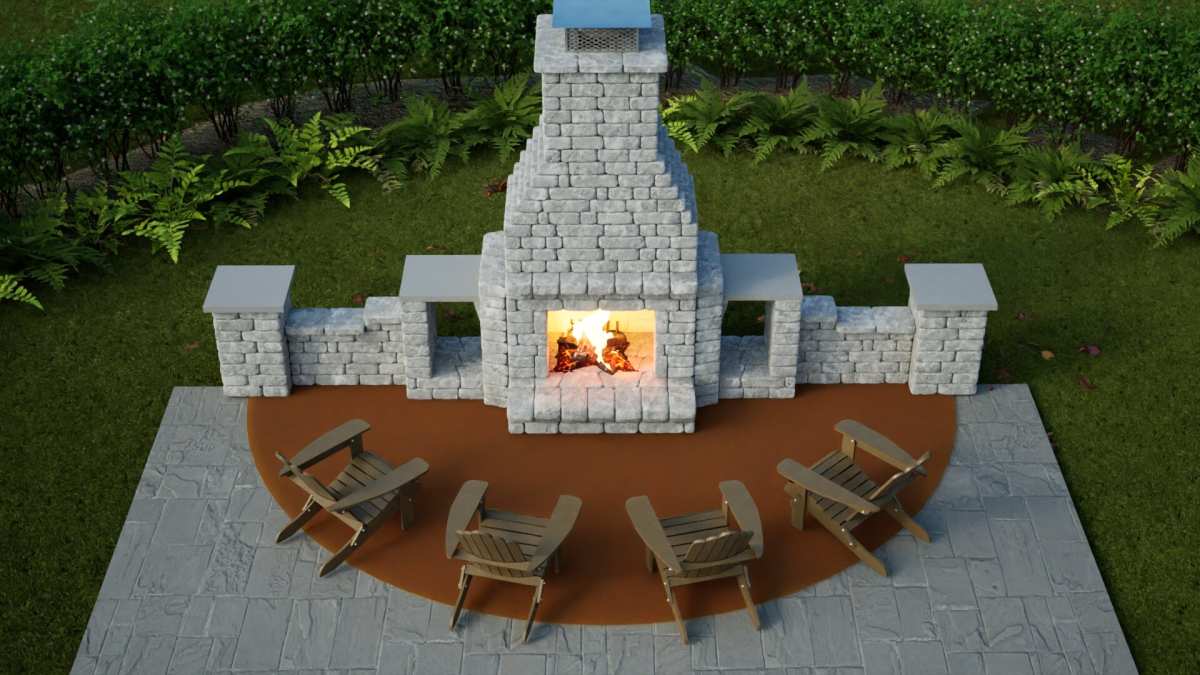
Many people approach outdoor fireplaces with indoor assumptions. They think in terms of draft, dampers, air volume, or how much space the fireplace is supposed to heat. That logic works indoors. Outdoors, it breaks down almost immediately.
An outdoor fireplace doesn’t heat air. It heats people. Understanding that distinction is the key to understanding why some outdoor fireplaces feel warm and satisfying, while others look impressive but leave everyone reaching for jackets.
TL;DR:
This article explains what actually controls heat in an outdoor fireplace, why firebox design matters more than accessories, how this standard firebox is already built around those principles, and what to do if you want even more warmth.
Indoor vs. Outdoor Fireplaces: Why the Rules Change
Indoor fireplaces are airflow systems. They operate inside an enclosed volume of air. Room size matters. Draft must be controlled. Dampers regulate airflow through the firebox and up the chimney. Efficiency is tied to how well warm air is retained in the space.
Outdoor fireplaces are different. There is no enclosed air volume. Any warm air produced is immediately replaced by cooler air. Draft is largely uncontrolled, and dampers don’t meaningfully retain heat in an open environment. Trying to apply indoor fireplace logic outdoors usually leads to disappointment.
Outdoor fireplaces succeed or fail based on radiant heat. Radiant heat travels directly from hot surfaces and flames to people and objects. It does not rely on trapping or circulating air. Outdoors, radiant heat is the only mechanism that reliably creates comfort.
What Actually Controls Heat Outdoors
Once you shift to a radiant model, the real control levers become clear.
Heat outdoors is governed by:
Where the fire sits relative to the opening
How much hot surface area faces outward
How long those surfaces stay hot
Whether people are positioned close enough to intercept that radiation
Firebox depth, mass, surface orientation, and seating distance matter far more than airflow tricks or add-on devices.
Firebox Geometry Matters More Than the Opening Size
The nominal opening of a fireplace gets most of the attention, but it’s a poor predictor of outdoor performance on its own.
What matters is the working geometry of the firebox.
In this standard firebox design, the internal proportions are:
Rear wall width: approximately 34.75 inches
Firebox depth: approximately 25.25 inches
Firebox height: approximately 27 inches
Side wall returns: approximately 17.5 inches
That depth pulls the fire inward rather than letting heat spill out of the opening. Flames rise against the rear wall instead of rolling forward and dispersing. Heat stays inside the masonry envelope long enough to be absorbed and re-radiated.
A shallow firebox may look dramatic, but outdoors it tends to lose radiant energy sideways and forward before it can be felt.
Firebox detail and dimensions for Cornerstone standard firebox kits
The Rear Wall Is a Radiant Surface, Not a Backdrop
In an outdoor fireplace, the rear wall is not decorative. It is one of the most important heat-producing elements.
When flames wash the rear wall:
The masonry heats to a high surface temperature
That surface becomes a radiant plane
Heat is projected forward toward seating
The rear wall in this firebox is tall enough and positioned correctly to perform that role. Instead of acting as a heat sink, it becomes part of the heating system.
This is one reason small decorative fires often feel weak: the rear wall never gets hot enough to contribute meaningfully.
Side Walls Reduce Heat Loss and Improve Comfort
The side returns in an outdoor firebox do more than frame the opening.
They reduce lateral heat loss, help contain the radiant field, and create a usable zone of warmth directly in front of the fireplace. Textured masonry performs especially well here, as it absorbs and re-emits heat more effectively than smooth or reflective surfaces.
Over time, as the firebox darkens from use, its emissivity increases and radiant output rises.
Fire Size Matters More Than People Expect
A well-designed firebox still needs a proper fire.
Outdoor fireplaces perform best with:
Well-seasoned hardwood
Medium to large splits
Compact, vertically active fires
Small decorative fires rarely generate enough heat to engage the masonry mass. When the firebox never gets fully hot, radiant output stays low regardless of design quality.
This isn’t about burning more wood indiscriminately. It’s about allowing the system to reach its intended operating temperature.
Seating Distance Determines Whether Heat Is Felt
Radiant heat must be intercepted to be useful. For a firebox of this size:
Ideal seating distance is roughly 4 to 6 feet
Beyond about 8 feet, warmth gives way to ambiance
Lower seating captures radiant energy more effectively than tall furniture
Many “cold fireplace” complaints are actually layout issues rather than firebox issues.
Keep a close distance to the fire and radiant heat of the fireplace is best for warmth outside
This Firebox Is Already Doing the Primary Work
At this point, it’s important to be clear about one thing. This standard firebox is not relying on accessories to function properly. Its depth, proportions, rear wall height, and side returns are already doing the primary work of capturing and projecting radiant heat outdoors. When a firebox is designed this way, upgrades are not about fixing deficiencies. They are about increasing radiant output.
You Have a Good Outdoor Fireplace — But Want More Heat
Even with a properly proportioned firebox, there are times when more warmth is desirable.
Cooler shoulder seasons, wind exposure, larger seating areas, or simply wanting the fire to feel stronger close in are all reasonable motivations. At that point, the goal is no longer to correct design issues. The goal is to increase radiant intensity.
The Most Effective Way to Increase Outdoor Fireplace Heat
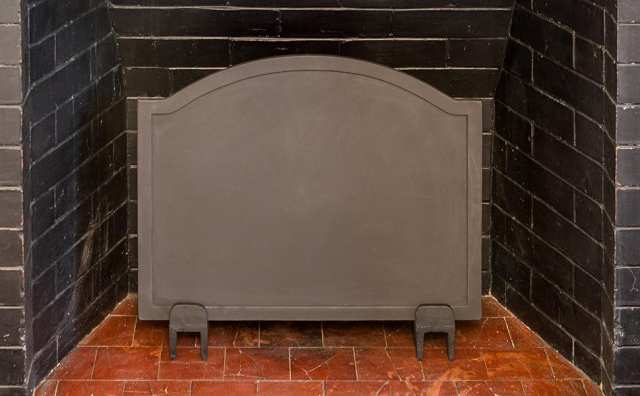
Because outdoor fireplaces rely on radiant heat, the most effective improvements are those that increase hot surface area facing outward. In an open outdoor firebox, the single most effective upgrade is a cast-iron fireback. A fireback:
Absorbs intense flame radiation
Heats to a higher surface temperature than masonry alone
Re-radiates that energy forward toward seating
Reduces heat lost into the rear firebox wall
When firebox geometry is already sound, a fireback doesn’t change how the fireplace works. It amplifies what it already does well.
What Helps Less (or Not at All)
Outdoors, some commonly suggested upgrades offer little return:
Grate heat exchangers rely on moving air, which is quickly lost
Glass doors don’t meaningfully trap heat in open environments
Thin reflective panels lack mass and cool too quickly
Trying to “aim” heat with shiny surfaces often creates glare without warmth
Screens and glass doors can help stabilize fires in windy conditions by limiting direct airflow into the firebox. Outdoors, however, they do little to increase warmth and can reduce the amount of radiant heat felt in front of the fireplace. They are best viewed as wind-management tools, not heat-increasing upgrades.
Understanding the System Leads to Better Results
Outdoor fireplace warmth isn’t accidental, and it isn’t achieved through shortcuts. It comes from:
Firebox geometry that supports radiant projection
Enough mass in the right places
Flames interacting with hot surfaces
Seating positioned to capture radiant energy
Once those fundamentals are in place, increasing warmth becomes straightforward and predictable. Understanding how the system works leads to better fires, better layouts, and better experiences — without guesswork.