
No. You cannot build a masonry outdoor fireplace on a wood deck. Not on a good deck, not on a new deck, not on a deck someone beefed up with extra joists.
But that is not the end of the conversation, and if you came here hoping for a fireplace where your deck is, you can probably still have one. It just doesn’t go on the deck. It goes beside it, on its own footing, at a height that makes the two read as one space. That is a real solution, and we’ll get to it.
First, why the answer is no — because understanding the why is what keeps you from talking yourself into something that fails.
TL;DR:
You can’t build a masonry fireplace on a deck. The weight and the deflection rule it out; trapped moisture would rot the deck from underneath; and most fundamentally, it puts a permanent structure on a replaceable one — backward from how building works.
What you can do is put the fireplace on its own footing beside the deck, raised to deck height, with an air gap between them and nothing connecting the two. That’s a fireplace where you wanted one, built the right way around.
Fire pits are a different question with a worse answer. Wood-burning on a deck is legal in plenty of places and still a bad idea. Gas is better, and we’ll say so plainly. Past that, it’s yours. We’ll give you the risk and the reward as straight as we know them. The responsibility and the liability are yours — they always were.
Why a fireplace can’t go on a deck
A masonry outdoor fireplace weighs somewhere between 7 and 14 tons. Could it be engineered? Sure. With enough time and money, a “deck” framed from I-beams or 8-inch square tubing could be made to carry it. That takes an architect, an engineer, and a welder. If you have those three people on payroll, you don’t need this article. For everyone else, the answer is no.
And weight is only the first of three problems.
Deflection
A deck that holds a load is not the same as a deck that holds it still. Framing flexes. That’s normal, and for people and furniture it’s fine. Masonry does not flex. Mortar joints crack or loosen, and a cracked firebox is not a cosmetic issue.
Trapped moisture
Say you solve the weight and the movement. Now you have masonry sitting on wood, and you need a waterproofing membrane between them. That membrane keeps water out from above and traps it below. Wood that can’t dry eventually 9quickly0 rots. You’d have built a slow failure into the one part of the assembly you can never inspect.
The BIG issue that actually matters: you’d have it backward
A permanent structure does not belong on a replaceable one.
Decks are consumable. Boards get replaced. Framing gets replaced. The whole thing gets torn off and rebuilt every few decades, and that’s not a failure — that’s what a deck is.
A footing is the opposite. It is meant to be the most permanent thing on the property. That’s why archaeologists dig up foundations from buildings that vanished two thousand years ago. The foundation is what stays. You build a wood house on a masonry foundation. You do not build a masonry house on a wood foundation.
Notice we haven’t mentioned fire yet. All four of these problems exist before a single log is lit.
What to build instead: put the fireplace beside the deck
The fix isn’t clever. It’s just correct.
The fireplace gets its own footing at ground level and stands beside the deck, raised so the fireplace sits at deck height instead of down in the yard. The deck stops short of it. The two never touch.
This is what the Bellrise Elevated Fireplace Kit is. It’s a fireplace built on a matched raised base — a tall hearth structure sized to the fireplace above it, with the same finished look. The outer skin matches the fireplace kit’s random-look colored tumbled block. The bearing wythe inside is standard CMU that you buy locally, which keeps the cost of the height down. From where you’re sitting, it reads as a fireplace on your deck. Structurally, it has nothing to do with your deck at all.
The geometry:
- The base sits on its own footing at grade
- The structure abuts the deck edge with a 1–2 inch air gap between them
- The hearth lands 8 or more inches above the finished decking height
- The hearth is 16 inches deep and overhangs the course below by 4 inches, projecting out past the base to shield the deck edge and add room for embers and log rollout
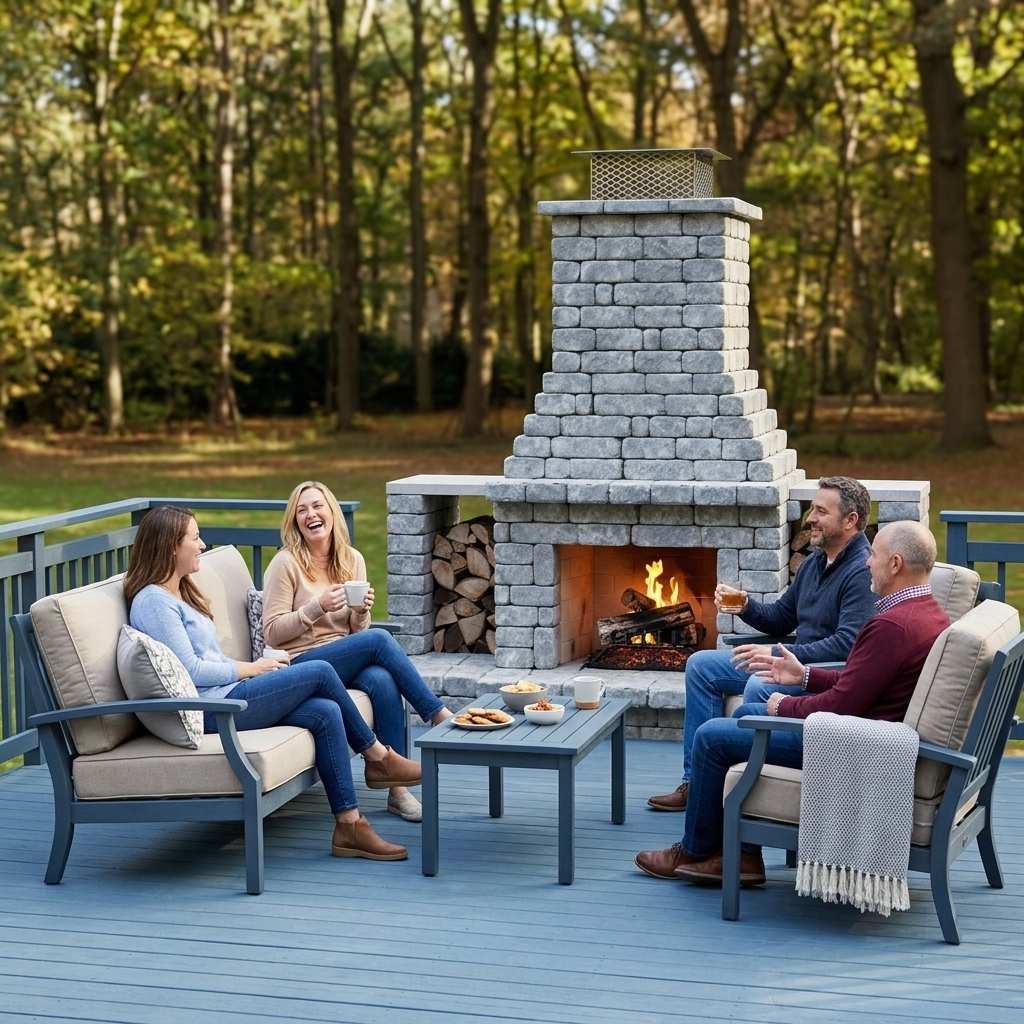

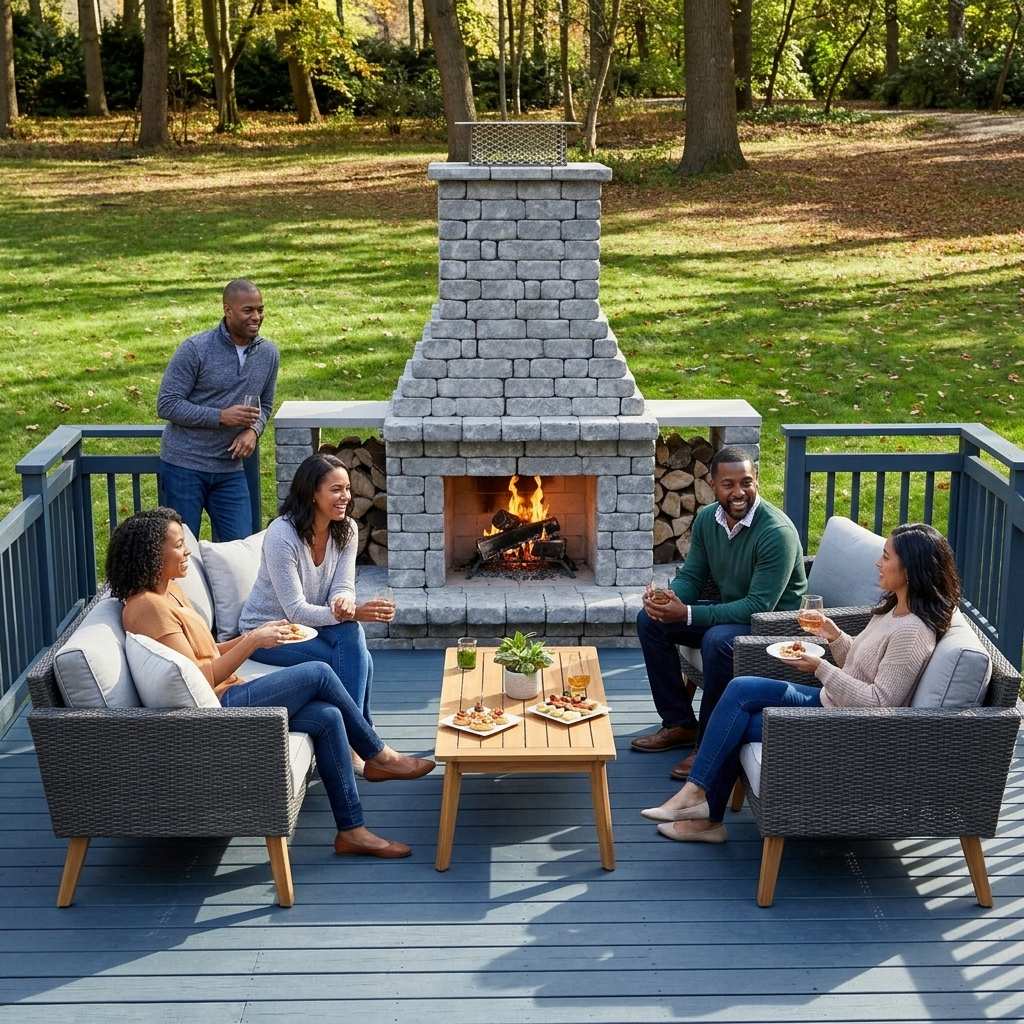
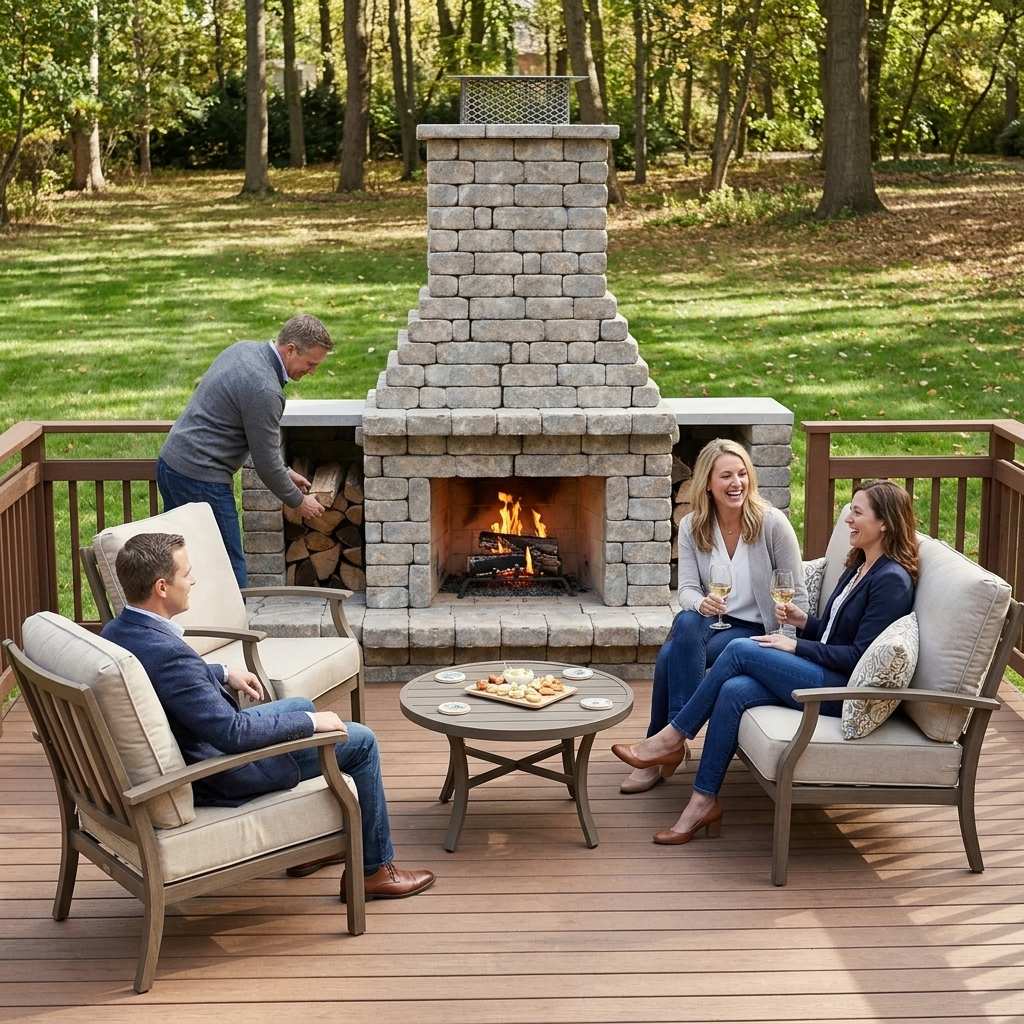
It also works on raised patios, which is worth saying out loud. Plenty of patios get built up to deal with a grade change, and they present the same problem — finished surface well above where a fireplace footing has to start. Same solution.
And this isn’t just our opinion about masonry. Trex — the largest composite decking manufacturer in the country — recommends the same approach for their own product. Their guidance for a gas fireplace on a deck is to cut around the decking rather than install on top of it, place fire-resistant material underneath, and use a protective stone wall or similar to contain the fire and shield the decking from heat. That’s our solution in a nutshell, described by someone with no fireplace to sell you.
The footing: Build concrete piers to your frost line
Concrete piers to frost line.
Concrete, specifically. We offer a crushed stone foundation for some applications — this is not one of them. A fireplace carried on a raised base beside a deck goes on concrete. The footing is two large for a floating footer. The movement will show up and undermine your structure over the years, causing settling and gaps. Build it on a concrete pad.
Your frost line is the part we can’t give you a number for, because it’s geographic. It varies by jurisdiction, and the depth that’s fine in Georgia will heave your fireplace out of plumb in Minnesota. Your local building department knows the number for your address.
Everything else — pier dimensions, concrete spec, and reinforcement — is in the concrete foundation instructions. Download it before you order anything, not after. This is the part people want to skip because it’s underground and nobody will ever see it. It’s also the part the entire argument above rests on. The footing is the permanent thing. Do it right.
The air gap: why 1–2 inches, and why you never close it
The gap is not a tolerance. It is not there because we couldn’t make the parts line up. It is a functional part of the assembly, and it has two jobs.
Job one: no combustible material touches the fireplace. No decking, no framing member, no railing post, nothing. That’s it. That’s the rule.
Job two: there is nowhere for an ember to lodge against wood. This is the one people miss. An ember on an open deck surface is a nuisance — you sweep it off and put it out. An ember wedged into a tight seam between masonry and wood, where you can’t see it and can’t reach it, is how you get a smoldering fire that starts hours after everyone went inside.
The gap means there is no seam. Anything that finds its way in goes straight down. Straight down to what, exactly? Nothing. A deck is a suspended structure. The rim joist is the last piece of framing at the deck edge — past it, there’s open air to grade. So an ember in the gap falls to the ground or to the footing below, which is where you want it. Make sure there is nothing flammable in that area. There should be no old wooden lattice, old logs, dried grasses, etc. Be sure that the embers have a safe place to land if it ever happens- and make sure the ember goes out. A layer of pea gravel should suffice.
Which brings us to the three things people want to do to that gap, and why all three are wrong:
- Don’t screen it. A screen catches debris and holds it in the gap permanently. You’ve built a lint trap next to a firebox.
- Don’t flash it. Same problem, plus you’ve now bridged masonry to wood with a rigid piece of metal, which reintroduces the movement issue you avoided.
- Don’t attach anything. The fireplace is not a foundation. Nothing gets ledgered to it, no joists bear on it, no decking gets fastened to it. If you find yourself reaching for fasteners, stop — you’re rebuilding the exact mistake this whole design avoids.
It’s called an air gap because it needs to be air. Keep it clear. Sweep it out the way you’d clean your gutters — periodically, and definitely before fire season.
Why not smaller than an inch? Because half an inch isn’t clearance, it’s a crack, and it does everything a seam does.
Why not bigger than two? Because a gap wide enough to swallow a toe, a heel, a chair leg, or a kid’s fingers has traded a fire problem for an injury problem. Two inches is the ceiling.
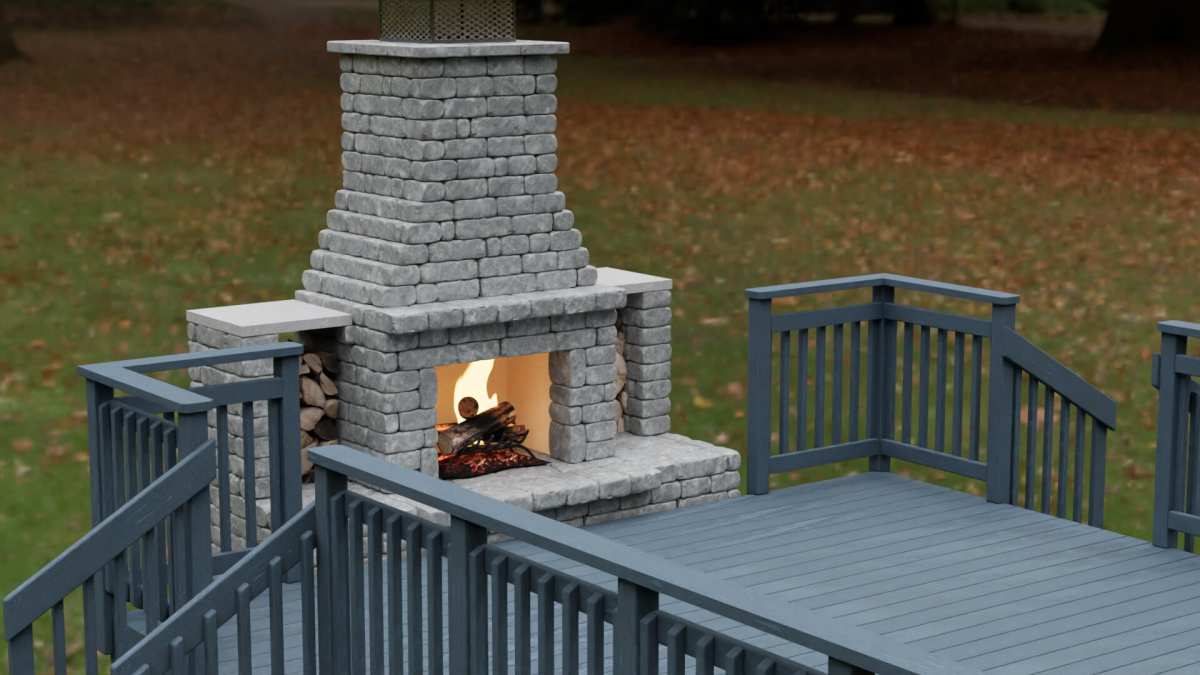
How high can the deck be?
- Up to 16 inches — the standard kit handles it
- Higher — base risers are available in 8-inch increments
- Over 32 inches — possible, but we’d tell you it’s out of the scope of a good idea
- In between — adjust the footer height. When you need less than a full course of block, you make it up underground rather than adding a partial course above.
Existing deck or new build doesn’t matter, as long as you can get a proper footing in at ground level next to it.
Can you put a fire pit on a composite deck?
Most people assume composite is the safe one. That’s half right, and the half that’s wrong will cost you a deck.
Wood chars. Given enough heat, it ignites, but it fails gradually, and you can often sand out light surface damage.
Composite deforms, and it starts a long way below wood’s ignition point. Trex publishes this themselves: Trex can soften at temperatures as low as 176°F, and heat or embers from a wood-burning fire can damage the decking. That is barely above the temperature of a hot cup of coffee, and it is nowhere near hot enough to scorch wood.
Composite is also not repairable the way wood is. The color and the protective shell are in the surface. You can’t sand a melt out of it — you replace the board.
So: composite is more resistant to catching fire and less resistant to being ruined. If your deck is composite, the argument for keeping fire off it entirely gets stronger, not weaker.
Worth knowing, too: Trex’s own guidance is that wood-burning fire pits should not be placed directly on their decking unless a heat barrier is used — and that they have no specific barrier to recommend. The largest manufacturer in the category declining to name a product that works should tell you something about how solved this problem is.
Igniting, burning, smoldering, and staying lit are four different things
Almost every article on this subject collapses all of this into “fire is dangerous.” That’s useless for making a decision, so here’s the actual breakdown.
Ignition is a material reaching the temperature where it starts to combust. It depends on the material, the temperature, and how long the heat is applied. A brief flash of heat and a hot object sitting in one place for two hours are very different exposures.
Burning is an open, visible, self-sustaining flame. It’s the one everybody pictures, and it’s also the one you’re most likely to catch, because you can see it.
Smoldering is combustion without flame. Slow, low-temperature, often invisible, and it can run for hours before it breaks into open flame — usually at two in the morning, after everyone has gone to bed. This is the one that burns houses down. It’s also why a single ember lodged where you can’t see it matters more than a shower of sparks you watched land and go out.
Staying lit is whether a small ignition survives long enough to become anything. A spark on damp decking dies. The same spark in dry leaves in a tight seam does not.
Read those four again with your own deck in mind. That’s the real risk assessment, and it’s yours to make — not a warning label’s.
Can you put a fire pit on a deck?
Different question, different answer. And our answer here is more opinionated, because the physics are worse than they look.
A fire pit is more dangerous on a deck than a fireplace, despite being smaller. Three reasons:
- It’s open 360 degrees. A fireplace has one opening, facing one direction. A fire pit throws embers in every direction, including toward the parts of your deck you’re not looking at.
- There’s no hearth. A fireplace has a hearth in front of the opening — a non-combustible landing zone that catches what comes out. A fire pit has no equivalent. Whatever leaves the pit lands on whatever is there.
- There’s no mass. A masonry fireplace absorbs heat and re-radiates it gently. A metal pit dumps it, including downward.
The one thing a fire pit does better: log roll is mitigated. Logs in a contained bowl don’t roll out onto the deck the way they can from an open firebox. Credit where it’s due.
Chimineas rate better than open pits — a single opening is a real improvement. But there’s still no hearth in front of it.
The grate problem
The usual answer to ember throw is a spark screen over the pit. In practice this fails, and it fails predictably:
- A screen over the fire is no fun, so it comes off and doesn’t go back on
- Screens burn out fast
- It’s awkward to remove for tending the fire, and once you’ve got it off you need somewhere safe and non-combustible to set a glowing-hot piece of steel — on a deck, there isn’t one
A safety device that people take off and don’t put back is not a safety device.
What we actually recommend
Gas. Fire tables and fire bowls, with an LP tank option available on ours. No embers, no sparks, no popping, and it goes out when you turn it off. Fire bowls are round if that’s the look you want.
Two honest caveats:
It’s connected to your house. A gas line or a tank is now part of your deck. That’s a different category of risk than a bag of firewood, and it deserves respect and periodic inspection.
Cheap units often aren’t even running on propane. A lot of the smaller tabletop pits and bowls at the big-box stores are essentially disposable. Many even burn gel fuel cans, bioethanol, or butane canisters instead — Home Depot has whole product categories for gel fuel and ethanol fire pits. Those fuels are convenient, but they’re single-use, low-heat, and expensive per hour compared with a refillable tank. Check what a unit actually burns before you buy it. And even on propane, the $300 big-box pit usually has a small, poor burner — costly to run and not very effective at the one thing you bought it for. If the plan is to spend a little to get fire on the deck safely, the little-spent version tends to deliver neither.
Can you burn wood on a deck? With every precaution in place, yes — people do it. We’re not going to pretend otherwise, and we’re not going to pretend we can stop you. We don’t recommend it. We’d rather you do it knowing exactly what you’re accepting than do it because someone told you it was fine.
Gas Options for Your Deck
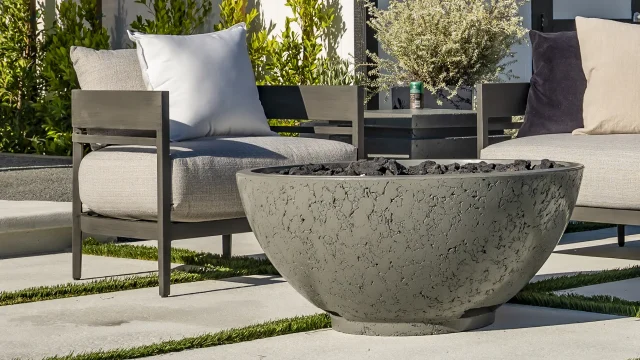
GFRC construction in a round profile. Gas-fired, deck-appropriate, and built to hold up outdoors season after season. LP storage available in a matching side table.
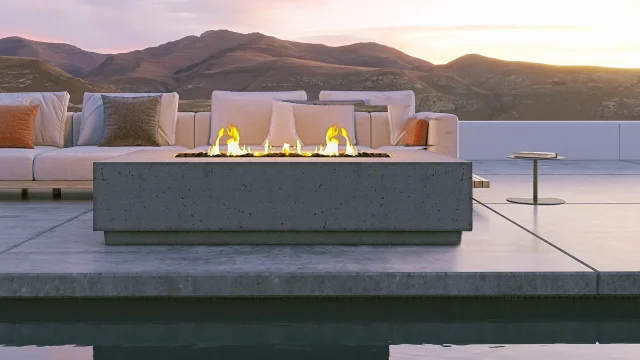
Glass fiber reinforced concrete, built to sit on the deck and stay there. Gas — no embers, no sparks, no popping. Add the matching side table to store the LP tank out of sight.
What goes under a fire pit on a wood deck?
Here’s an honest answer you won’t find on the product pages: nobody has solved this, and every option trades one failure for another.
The problem is that a protector has to do two jobs that fight each other. It has to block heat from reaching the deck. And it has to not sit against the deck holding moisture, because trapped moisture is how you get staining, mold, and rot.
Run through what’s available:
Mats — usually silicone-coated fiberglass. They’re thin and lie in full contact with the deck. Even the sellers admit the moisture problem: Trex Protect advises not to leave pavers or protective mats on the deck for long periods, because they trap moisture and leave stains.
Pavers or stone — real thermal mass, and the same contact problem, plus weight sitting in one spot.
Raised-frame protectors — at least one product is built directly around this conflict, using volcanic rock fiber tiles in an aluminum frame on rubber feet that lift it off the deck for airflow, about three-quarters of an inch. That’s the right instinct. It’s also worth seeing clearly what you’re building: you are now building a small elevated pad on your deck, so you can put a fire on your deck. Three-quarters of an inch of air plus the thickness of the material — and at that point, ask yourself what problem you’re really solving and whether there’s a better place for the fire.
Nonflammable fiber pads are expensive, wear out, and hold moisture and biological growth.
If you’re going to do it anyway: non-combustible, extended well past the footprint of the pit, lifted off the deck if you can manage it, and picked up and moved regularly rather than left in place all season. Again- probably more trouble than people are willing to put up with- so they don’t. This reality is what makes these possible safe solutions unsafe.
What makes a fire pit “deck safe”?
Nothing. There is no standard that makes a fire feature “deck safe.”
There’s no UL listing and no ASTM specification that certifies a fire pit or fireplace as safe to use on a deck. When you see “deck safe” on a product page, that is marketing language, not a certification.
Fire ratings themselves are widely misunderstood. The common decking test is ASTM E84, the Steiner tunnel test, which measures how fast flame spreads across a surface. Class A is a flame spread index of 0–25, Class B is 26–75, Class C is 76–200, and most untreated lumber and plywood is Class C.
Here’s the part nobody mentions: the standard E84 test exposes the material to flame for ten minutes, and to be classified “ignition resistant,” a material has to pass the extended version — a full thirty minutes. So “Class A” and “ignition resistant” are two different claims, and neither one is a fire-resistance rating, which is a different test measured in hours.
Everything has a fire rating. Your underwear has a fire rating— a different test under a different standard, but a rating. It might be measured in seconds. It’s still a rating. “Fire-rated” tells you almost nothing until you know which test, for how long, and what it measures.
If you’re re-decking anyway, Class A materials do exist and are worth knowing about: fire-retardant-treated lumber; several dense tropical hardwoods that pass untreated — ipe, cumaru, machiche, and jatoba have all met Class A criteria; thermally modified bamboo, with MOSO reporting a flame spread index of 10 without chemical treatment; and some capped PVC lines. Just understand what you’re buying: flame spread across a surface is not the same as resistance to one hot ember sitting in one spot for an hour, which is your actual failure mode.
What we build, and what that does and doesn’t mean
Our fire features are 100% solid masonry with solid masonry firebrick, and the spark arrestor is stainless steel. That’s real, and it matters.
It also doesn’t make anything 100% safe. No fire rating, dimension, material, or design does. We ship a kit — a set of parts and instructions. They’re straightforward to follow, but we don’t know what you’ll build, where you’ll put it, or how you’ll use it. The owner assumes liability, just like with anything else on your property.
Which is why the most useful thing we can tell you is this: if you’re unsure, or if you already know it’s a bad idea, and you’re shopping for someone to tell you otherwise — don’t. You know the difference between researching a decision and looking for permission.
How much clearance does an outdoor fireplace need?
Clearance matters as much as anything on this page, and it’s not one number.
- The house wall — a fireplace against your siding is a fireplace against your house. This is a no-no. This is no longer a disconnected outdoor fireplace because it is connected to your home. It will have to meet a host of new code requirements.
- Railings — this is a big part of why the Bellrise is wide and the firebox is flanked on both sides, so handrails stay clear of the opening
- Overhead — soffits, pergolas, roof overhangs, awnings, and branches. People check what’s beside them and forget to look up. If you don’t build against or near a structure, most of these take care of themselves. Build outside your pergola or pavilion.
- Trees, and especially evergreens — evergreens are resinous and burn hot and fast. A fireplace under an evergreen tree is a no from us regardless of everything else on this page.
Codes, permits, and your HOA
Nobody can answer this for your address, including us.
Here’s why it’s genuinely unanswerable in an article: the IRC exists, but jurisdictions adopt different editions of it on different schedules. Local municipalities layer their own ordinances on top, often stricter. Your HOA can restrict further. A landlord can have house rules that override all of it. Some municipalities prohibit portable or permanent wood-burning fire features on decks outright.
Where to actually look, in order:
- Your local building department — the only authority on what’s adopted at your address, plus permits and frost depth
- Your fire marshal — often has the say on outdoor burning, and may have restrictions the building department doesn’t
- The state agency that adopts building codes — tells you which code edition applies statewide before local amendments
- Your HOA covenants — read them yourself rather than asking a neighbor
- Your homeowner’s insurance carrier — not a code authority, but they have opinions about fire features, and you’d rather hear them now
That’s an afternoon of phone calls. It’s cheaper than the alternative. Ask permission on this one- NOT forgiveness.
When we tell people no
We do it regularly, and it’s almost always one of these:
Under an evergreen, or too close to any tree. The most common no we give.
Too close to the house. Sometimes the space just isn’t there.
Old, dried-out decking. If your boards are gray, cracked, and thirsty, that’s not a fire problem you can solve with clearance — that’s a deck that needs replacing. Do that first, and then talk about fire.
And there’s a category that isn’t about the site at all. The most common mistake we see isn’t technical — it’s shopping for a different answer.
Always take professional advice from someone with local knowledge. Not every professional is right, but the consensus usually is. If three contractors tell you something is a bad idea, don’t keep fishing for a fourth, fifth, or sixth who’ll say yes. There is always somebody who will take your money, build the bad idea, and leave you with the consequences.
If you’ve read this far, you’re probably not either of those people.
If you do build one, operate it like this
- Screen in place whenever there’s fire. Not most of the time. Whenever.
- Deep fire grates and andirons to hold burning logs securely back in the firebox. Between a 16-inch hearth and a properly deep grate, you have a real safety zone — nothing should be getting out. If something does, that’s information.
- Never leave it unattended. Logs shift and roll as they burn. Embers pop. Every one of those events is fine if you’re sitting there and a problem if you’re not.
- Gas logs. Strongly recommended, and the single biggest risk reduction available on this entire page.
- Keep the air gap clear, and check it before and during fire season.
The short version: what to do
You can’t build a masonry fireplace on a deck. The weight and the deflection rule it out; the trapped moisture would rot the deck from underneath, and most fundamentally, it puts a permanent structure on a replaceable one — backward from how building works.
What you can do is put the fireplace on its own footing beside the deck, raised to deck height, with an air gap between them and nothing connecting the two. That’s a fireplace where you wanted one, built the right way around.
For fire pits, wood-burning on a deck is legal in many places and still a bad idea, for reasons that are geometric rather than squeamish. Gas is the better answer, and we’re not shy about saying so. Everything else is yours to weigh. We’d rather hand you the information and let you decide than tell you what you wanted to hear.
Ready to look at the hardware? See the Bellrise Elevated Fireplace Kit for Decks, and download the concrete foundation instructions before you order.
Build it beside the deck, not on it.
The Bellrise puts a real masonry fireplace at deck height on its own footing — the way it should have been done in the first place.