
An outdoor fireplace can cost anywhere from under $1,000 for a freestanding steel unit to well over $20,000 for a custom masonry build. Where yours lands depends less on the fireplace you pick and more on what the listed price leaves out.
The ranges in this business are wild, and the lines between types blur. We’ve seen expensive “DIY” kits that were really a pile of material and a plan, with hours of cutting, grinding, wet work, and finishing that still needed a professional. A lot of what’s published about fireplace costs is too rosy, and the rest can scare you off. We’re not trying to do either. These are real-world numbers so you can go in informed. Freight, local material/labor prices, and site conditions can move any of them. Treat them as a general guide, not a quote.
TL;DR:
A freestanding steel fireplace costs under $1,000, and most won’t last. Anything finished with stone veneer, whether a metal unit, a metal insert, or a lightweight modular core, typically lands between about $9,500 and $21,000 once you add the stone and $3,000 to $12,000 in veneering labor. A custom site-built masonry fireplace starts around $20,000. A structural masonry kit with a finished face costs about $4,000 to $11,000 plus a foundation, because there’s no veneer and no mason. Gas adds a professionally run line and a burner system to any of these.
The Short Answer
| Type of fireplace | Price you’ll see listed | Typical finished cost | Who usually builds it |
|---|---|---|---|
| Freestanding steel fireplace | About $650–$900 | Same as listed | You, in an afternoon |
| Built-in metal unit or insert, framed and veneered | About $3,500 for the unit | About $9,500–$20,500, plus framing | Carpenter and mason |
| Lightweight modular core, veneered | About $5,000 for the core | About $10,000–$21,000 | Mason |
| Structural masonry kit, finished face | About $4,000–$11,000 | Kit price plus foundation | DIYer or handyman |
| Site-built custom masonry | Quoted per project | $20,000 and up | Mason |
Listed prices come from current retail listings, and they’re the low number you’ll see first. Finished costs add the parts, stone, and labor those listings exclude. Veneering a fireplace typically adds $3,000 to $12,000 in labor and materials. That’s the smallest crew, a mason and a helper, getting to the job, bringing the mixer, buying the sand and mortar, then laying, cutting, jointing, and cleaning. A bigger shape or natural stone pushes it toward the top of that range. Having a mason build the fireplace itself adds $6,000 to $20,000 depending on the design, scale, and location.
You’ll also see portable chimineas, most of them $150 to $600. They’re fire features, not fireplaces: no hearth, no mass, nothing permanent. They’re not counted here.
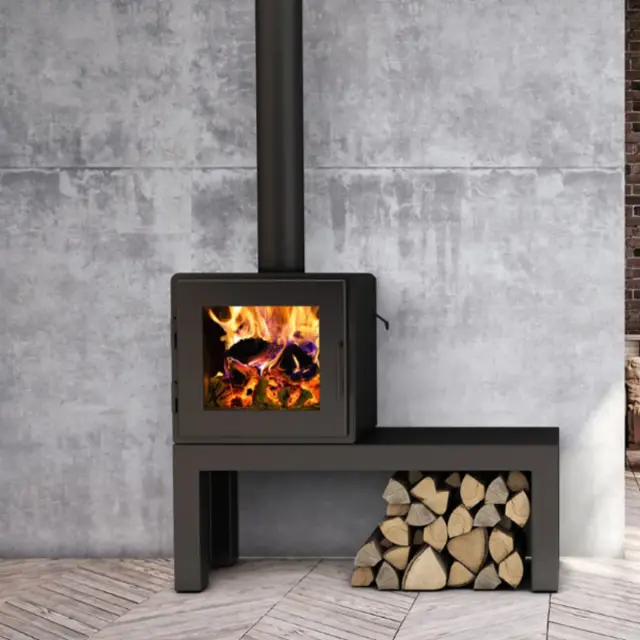
Prefab Metal Fireplace 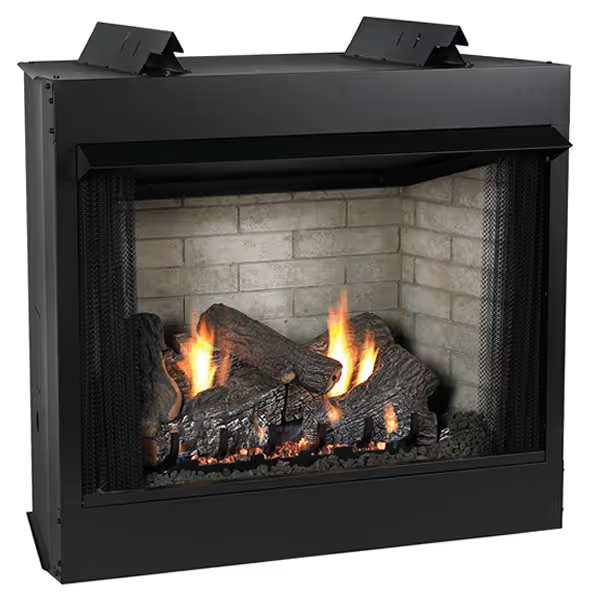
Metal Firebox Insert 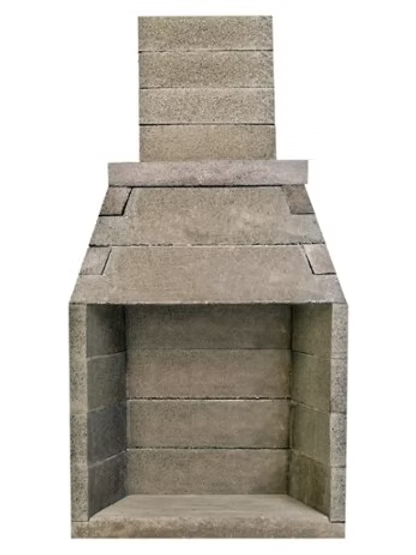
Lightweight Masonry Fireplace 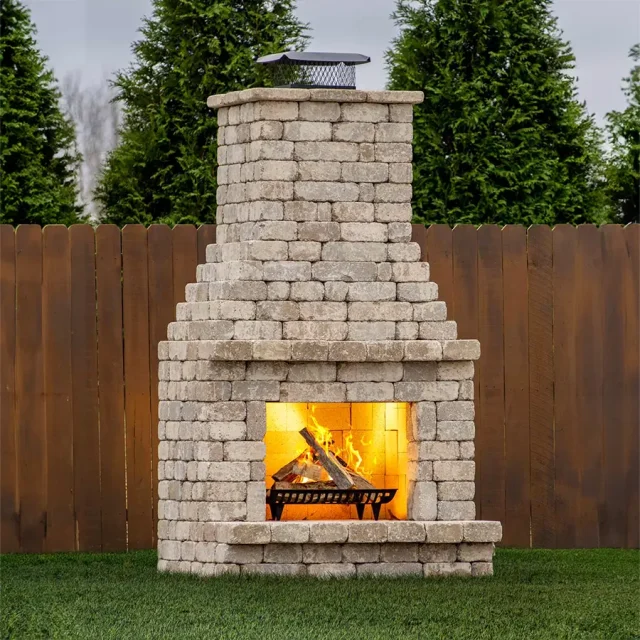
Solid Masonry Fireplace Kit
Why the Price You See Isn’t the Price You Pay
Most people meet an outdoor fireplace through a photo: a finished build in someone’s backyard, with every option, full stone, landscape lighting, and a fire going. Then they click through, and the price is for the core or firebox only.
The mantel is often another $1,000 to $1,500. The core may have no chimney, so you need pipe. The firebox innards may be sold separately. Then comes the stone, the mortar, the mixer, and someone who knows how to use them. One cast masonry core we priced lists at $4,399, but it doesn’t include the firebox or veneer, and the firebrick kit it needs for the warranty is another $1,350. That’s $5,749 before a single stone goes on.
When you compare prices, compare what’s in the box, not the photo.
Freestanding Steel Fireplaces
About $650–$900 · Quick and cheap, but most are a fire feature you’ll replace, not a fireplace you’ll keep.
The least expensive outdoor fireplaces are freestanding units of painted or powder-coated steel, bolted or welded together, with a short pipe chimney and a mesh spark screen. They sell at big-box and farm stores for about $650 to $900, weigh around 110 pounds, and assemble in an afternoon.
They burn wood, and they have a chimney, but they’re closer to a large chiminea than to a fireplace. The thin, multi-part units rust out like a cheap grill. Thick, artisan-made fireplaces of quarter-inch steel are a different story. They cost more, they last, and the rust is part of the charm.
Built-In Metal Units and Inserts
About $3,500 for the unit, $9,500–$20,500 finished · Light enough for tight spots, but the enclosure and stone cost more than the fireplace.
Many outdoor fireplaces that look like masonry are built around a factory-built metal firebox. The unit is an appliance, not a structure. A stainless outdoor wood-burning unit lists at about $3,500. By the time you add the required liner and the parts you choose, such as a hood or drain pan, it’s about $1,000 more. It’s not optional, but you choose which parts. Then a carpenter frames the enclosure, and a mason finishes it with stone, brick, or manufactured stone panels.
Veneer costs more than people expect. Even a small fireplace takes about 100 square feet of flats and 32 linear feet of corners, and that still may not cover it. At current prices, that’s roughly $2,000 to $4,000 in stone alone, whether manufactured or natural thin stone, before mortar, sand, the hearth, or the extra block it can take to bulk out the shape so it reads as a real fireplace instead of a covered skin.
The framing and stone are a covering, not fire-resistant mass, and they have their own, often shorter, maintenance cycles. Most of these systems are gas-fired outdoors, which adds its own costs (see below).
Lightweight Modular Masonry Kits
About $5,000 for the core, $10,000–$21,000 finished · A real masonry process, but still veneered and still a mason’s job.
Modular kits use large, lightweight masonry units that are stacked and mortared into shape, then faced with stone or another finish. A typical core lists for about $5,000.
These feel more substantial than a framed enclosure, but they still depend on a surface finish for their appearance, and the venting often has to be set up by a specialist. They sit halfway between a kit and a trade build, and they’re commonly installed by masons who are comfortable laying block and veneer. Budget for the same stone and the same $3,000 to $12,000 in veneering labor as any veneered fireplace.
Structural Masonry Kits
About $4,000–$11,000 plus foundation · Finished face, no mortar, no mason: the kit price is close to the real price.
Structural masonry kits are built from full-depth masonry that forms both the firebox and the structure. The fireplace is the structure. There’s no hidden framing and no surface-applied finish to maintain.
The good ones arrive with a finished face, so you don’t need to buy or install veneer, and they stack without mortar or cutting. That’s what moves them out of the professional column: a capable homeowner, a handyman, or a hardscape contractor can build one. Listed prices run from about $4,000 to $11,000, depending on size and options, and the main added cost is the foundation – the same with most fireplaces.

Site-Built Masonry Fireplaces
$20,000 and up · Fully custom, fully professional, and priced by the mason’s hour.
A custom fireplace, brick or stone over block, built piece by piece by a mason, typically starts around $20,000. It allows complete customization, but it needs construction drawings, skilled labor, on-site decisions, and a longer timeline.
Working With a Mason
Everyone thinks a fireplace is a small project, and in a way it is. But if you hire a professional, the way you work with them affects the price as much as the materials do.
Take input from a competent craftsman. Don’t just roll over and let them build whatever they want, but they know which materials look good, which last, and which may save you money in the end. Many homeowners try to act as their own contractor and supply the materials. If you buy stone, or even mortar, that your mason doesn’t like, you’ll get worse work. Many masons also bid cost-plus. If they don’t make anything on sourcing, buying, and delivering material, they’ll likely raise the bid to make up for it. You may as well let them buy at their supply-house discount and take their cut. That isn’t shady. It’s how the trade works.
Choose carefully, too. A fireplace is an engine for burning wood, and the firebox, smoke chamber, and flue have to be sized to each other. Centuries of proportions and best practices go into one that draws well, and not every mason knows them. An architect who does is expensive. That’s why many masonry builds use a prefabricated firebox and chimney core: the part that makes it work has already been engineered.
The Costs Beyond the Fireplace
Whatever type you choose, budget for these:
- Foundation. Every masonry fireplace needs a level, stable base: a reinforced concrete pad or a compacted gravel floating foundation. Our outdoor fireplace foundation guide covers both. Ready-mix concrete and delivered gravel both come with order minimums, often around 4 cubic yards, so call your local supplier for a price. You’re paying for the minimum anyway, so size your forms to use it. Figure a little over, not under: you need enough to bring the slab or fill rock to your required elevation, and running short is worse than having some left. Even a small pad is too much to mix by hand. An 80-pound bag makes about 0.6 cubic feet, so a whole pallet of bags makes only about one cubic yard, and you’d still need a mixer.
- Chimney and cap. Check whether the chimney, flue, and spark arrestor are included or sold separately. You can’t have a fireplace without them.
- Firebrick. On some kits, it’s a separate purchase. Good firebrick is a few dollars a brick, and a firebox uses a lot of them.
- Hearth and caps. Real stone hearths get expensive fast. Cut natural stone that ran about $40 a square foot years ago now often runs $80 or more, and a hearth and chimney cap use a lot of it.
- Freight. A masonry fireplace weighs several tons and ships by truck. Check what delivery costs and where it’s dropped.
- Labor. For any veneered system, this is the biggest number on the list.
- Codes, permits, and HOA rules. Nearly every jurisdiction and most HOAs have rules about outdoor fireplaces: setbacks, clearances, burn rules, sometimes permits. Gas systems usually carry more of them, and for good reason. A leaking gas line can be explosive. A stack of firewood isn’t.
If the fireplace is part of a larger patio project, our guide to what an outdoor living patio costs covers the rest of the budget.
Gas vs Wood-Burning: Why Gas Costs More
Gas almost always adds cost. That’s why the cheap fireplaces at big-box stores usually aren’t plumbed at all: they run on expensive canisters or gel fuel instead of a gas line.
A real gas fireplace needs a properly sized gas line run by a licensed professional. Underground-rated gas pipe alone runs about $18 a foot. The rest depends on where you live: the cost is adding the line, the hookup, and getting it inspected and approved, the same as for a gas water heater or oven. It isn’t cheap, but it isn’t astronomical. Get a local price. Then you pay for the burner. A simple match-light burner kit starts around $430. An electronic-ignition kit runs about $2,000 for the burner alone, and the log set and media are extra. Those systems are also more finicky, especially outdoors, and your jurisdiction may require them.
Some people choose gas because they’re not confident building a fire. Don’t be scared out of wood. A wood-burning fireplace has no gas line to leak; it’s safer in many ways, and it’s the fire people picture when they want a fireplace in the first place.
We know a family that put in an in-ground pool even though the mother couldn’t swim, so they paid extra for a custom pool, four feet deep all the way across. She got in the pool, and eventually she learned to swim. Now they had a shallow pool that was always too warm and that nobody enjoyed.
If you’re buying a fireplace, learn to build a good fire. It isn’t rocket science. Within a week to a month of owning one, you’ll know how.
What the Price Difference Buys Over Time
At a glance, many finished outdoor fireplaces look alike. Over time, the differences show. Metal-based systems rely on manufactured parts with finite service lives. Veneer-based systems depend on fasteners and surface materials exposed to the weather. Masonry relies on mass and structure, the same principles behind traditional fireplaces and retaining walls.
None of these approaches is wrong, but each costs differently over its life. A cheaper fireplace that needs rebuilding isn’t cheaper.
DIY, Hybrid, or Professional Build
“DIY-friendly” covers a wide range of realities, and labor drives most of the price spread.
Some homeowners build the whole kit themselves. Others do the assembly and hire out the excavation, foundation, or gas line. Veneered systems mostly need a mason no matter what the box says. If a pro job needs equipment such as a skid steer or forklift, it belongs in the quote. The real question isn’t who does the work. It’s whether the system is designed to let you choose. Our guide to choosing the right outdoor project approach walks through the options.
The Cost Mistakes We See Most
- Budgeting from the photo. The fireplace in the picture usually has every option. Price the base, then add what you want.
- Forgetting the finish. On veneered systems, the stone and the mason often cost more than the fireplace.
- Choosing gas to avoid learning to build a fire. The line, the burner, and the approvals cost more than learning a skill you’ll pick up in a week.
- Ordering concrete or gravel short. Figure a little over. A second delivery costs more than the leftover.
- Skimping on the foundation. It’s the one part you can’t fix later without taking the fireplace down.
What a Cornerstone Kit Costs
Our outdoor fireplace kits start at $3,970, with free shipping in the contiguous US. A well-optioned kit runs about $6,500. Fully loaded, with double wood boxes, double wing walls, and two feet of chimney extension, it’s about $9,000, and that’s about as far as they go. Every kit is solid structural masonry with a firebrick-lined firebox, an integrated mantel, a finished tumbled-stone face, and a stainless spark arrestor chimney cap. Two people can build one in 10 to 16 hours on a prepared foundation.
Questions
Is an outdoor fireplace worth the cost?
If you’ll use it season after season, a permanent masonry fireplace becomes the anchor of an outdoor living space and holds up for decades. If you only want occasional fire, a fire pit or a portable unit costs far less.
Is a fireplace kit cheaper than hiring a mason?
Usually, by a wide margin. A mason can add $6,000 to $20,000 in labor, and a fully site-built custom fireplace typically starts around $20,000. A structural kit with a finished face removes most of that labor.
Does a gas outdoor fireplace cost more than wood-burning?
Almost always. A gas fireplace needs a professionally installed, properly sized gas line, a hookup, and approval, plus a burner system. Electronic-ignition systems cost more still. Wood-burning needs none of that.
Why do outdoor fireplace prices vary so much?
Because listed prices include different things. One price covers a core with no chimney, firebox, or finish. Another includes a finished face, firebrick, and a chimney cap. Compare what’s in the box.
Explore Outdoor Fireplace Kits
See the full range of fireplace kits and masonry systems, with layouts, details, and real-world applications to help you choose the right fit.